

How to Launch a Product Successfully With the Right GTM Strategy
- teamraservices
- Jan 7
- 3 min read

Launching a product without a clear Go-To-Market (GTM) strategy is one of the biggest reasons products fail, even when the offering is strong. In today’s competitive market, success is not just about building a great product, it’s about launching it to the right audience, at the right time, with the right message. A well-defined GTM strategy ensures alignment between product, marketing, sales, and customer success, turning launches into measurable business outcomes.
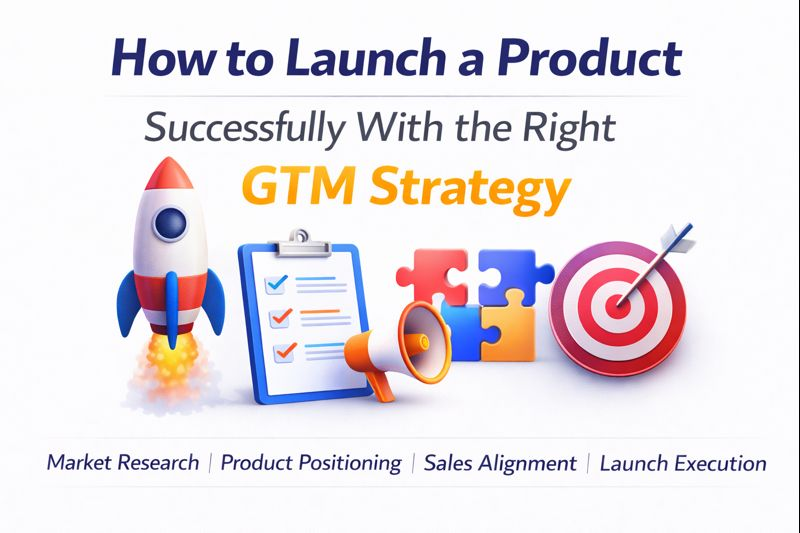
What Is a Go-To-Market (GTM) Strategy?
A Go-To-Market strategy is a structured plan that defines how a product will reach its target customers and achieve competitive advantage. It covers positioning, pricing, distribution, messaging, and launch execution. A strong GTM strategy reduces risk, accelerates adoption, and improves revenue predictability.
Key Elements of a Successful Product Launch GTM Strategy
1. Clear Target Market Definition
Understanding who your ideal customer is forms the foundation of your GTM strategy. Identify pain points, buying behavior, and decision-making roles to ensure your messaging resonates.
2. Strong Value Proposition
Your value proposition should clearly communicate why your product exists and how it solves customer problems better than alternatives. Simplicity and clarity drive faster adoption.
3. Pricing and Packaging Strategy
Pricing must align with perceived value, market expectations, and business goals. Transparent pricing builds trust and removes friction during the buying journey.
4. Channel Selection and Distribution
Choosing the right channels, direct sales, digital marketing, partnerships, or marketplaces, ensures your product reaches customers efficiently.
5. Sales and Marketing Alignment
A successful launch requires close collaboration between sales and marketing teams. Unified messaging and shared goals improve conversion rates and customer experience.
Q & A: Go-To-Market Strategy for Product Launches
Q1: When should a GTM strategy be created?
A: Ideally, a GTM strategy should be developed before product completion. Early planning helps align product features with real market needs.
Q2: Is a GTM strategy only for large companies?
A: No. Startups and small businesses benefit even more from GTM strategies as they reduce wasted spend and improve focus.
Q3: How do you measure GTM success after launch?
A: Key metrics include customer acquisition cost, conversion rates, adoption speed, churn, and revenue growth.
Executing the Launch With Precision
Execution is where most launches succeed or fail. A phased rollout, clear timelines, internal training, and customer feedback loops help teams stay aligned. Pre-launch buzz, launch-day visibility, and post-launch optimization are equally important for momentum.
Post-Launch Optimization Matters
A GTM strategy doesn’t end at launch. Monitoring performance, collecting user feedback, refining messaging, and improving onboarding help maximize long-term success. Continuous optimization separates short-lived launches from scalable products.
The Future of Product Launch Strategies
Modern GTM strategies are data-driven, customer-centric, and agile. Companies that continuously test, learn, and adapt their approach are better positioned to scale faster and outperform competitors.
RA Services: Helping Businesses Launch and Scale Successfully
At RA Services, we help businesses design and execute high-impact Go-To-Market strategies that drive successful product launches. From market research and positioning to sales enablement and launch execution, our GTM solutions are built for growth, clarity, and results. If you’re planning a product launch and want to reduce risk while accelerating adoption, RA Services is your trusted GTM partner.
Our Go-To-Market Solutions
Market & Customer Research
Value Proposition & Positioning
Pricing & Packaging Strategy
Sales & Marketing Alignment
Launch Planning & Execution
Performance Tracking & Optimization
Have Questions?
📩 info@raconsultingservices.in 📞 Book a Free Consultation 📞 +91 95730 64713


Comments